Public Engagement & Knowledge Transfer
I strongly believe that as scientists it is our job not only to research, but to effectively communicate that research to the public. To that end, I actively engage in science communication / education on social media, and also engage with the public through museum outreach programs. I have also worked, and continue to work, with a number of different organizations dedicated to science education, and have also assisted in programs designed specifically for younger audiences and underrepresented communities. Details of these organizations and programs, as well as my role with them, are discussed below.
Professional Consulting
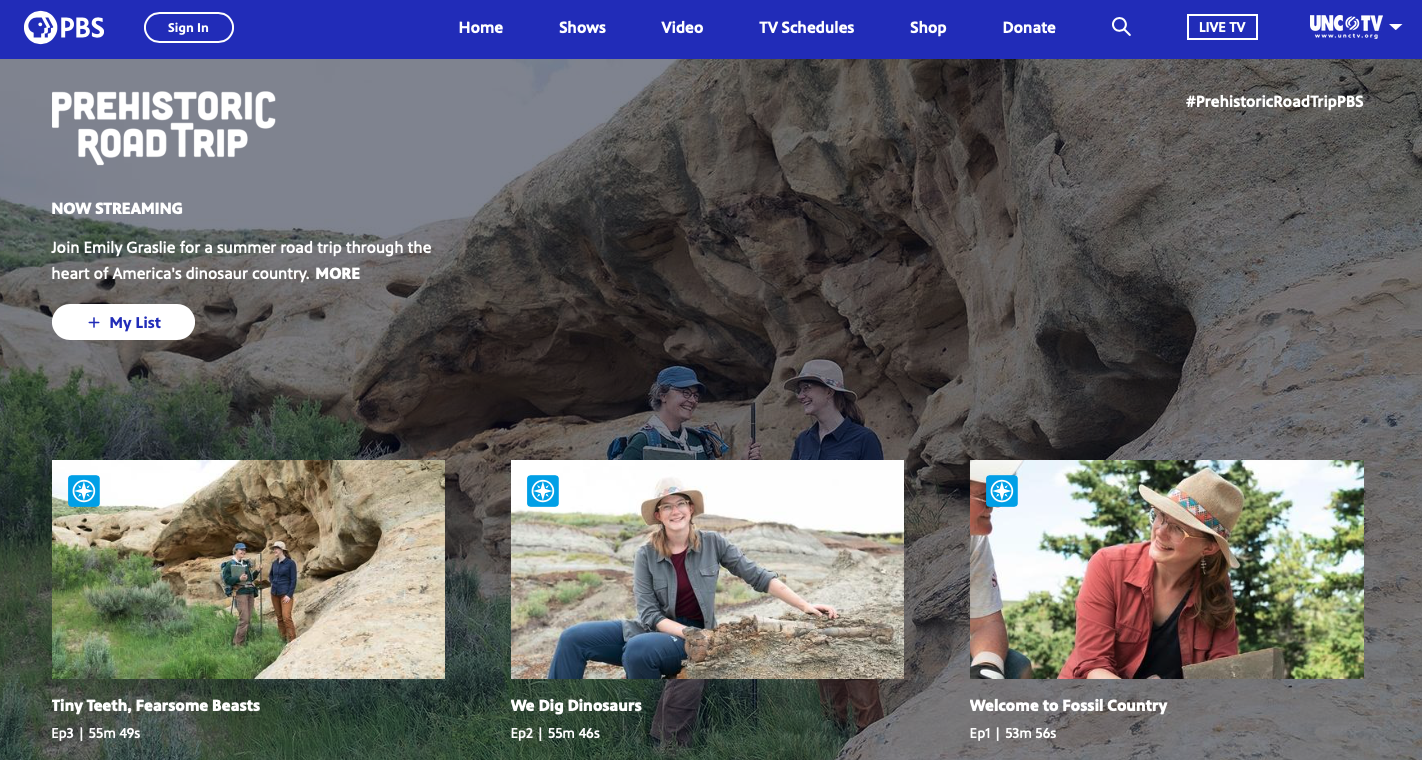
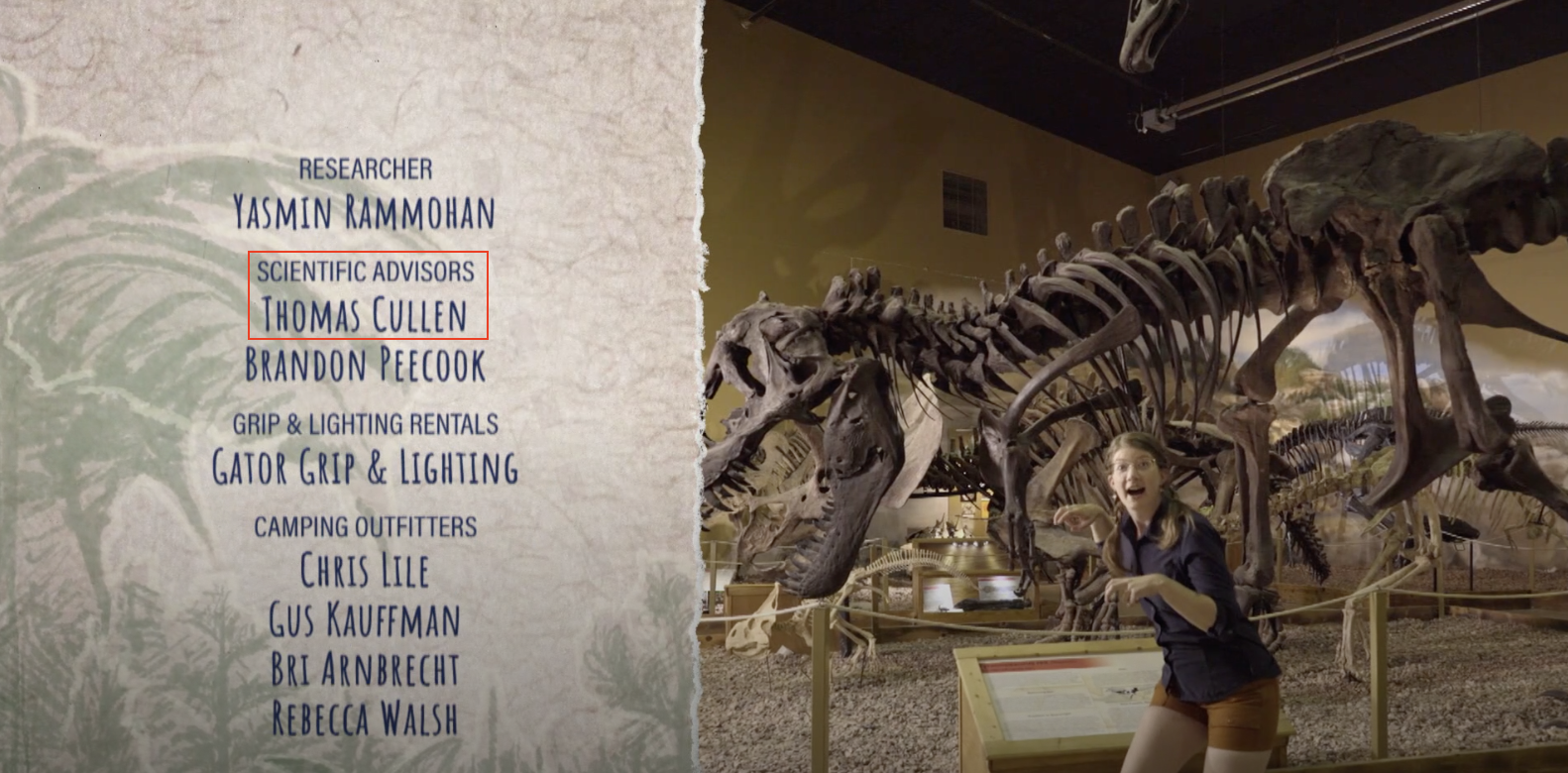
I have provided professional consulting services to Emily Graslie and the team at Window to the World Productions, assisting in the planning and development of the PBS documentary series Prehistoric Road Trip, which aired during the summer of 2020. I provided input into the choice of topics and researchers to be covered, as well as reviewed content for the program, including scripts, animations, and interviews for technical accuracy.
|
|
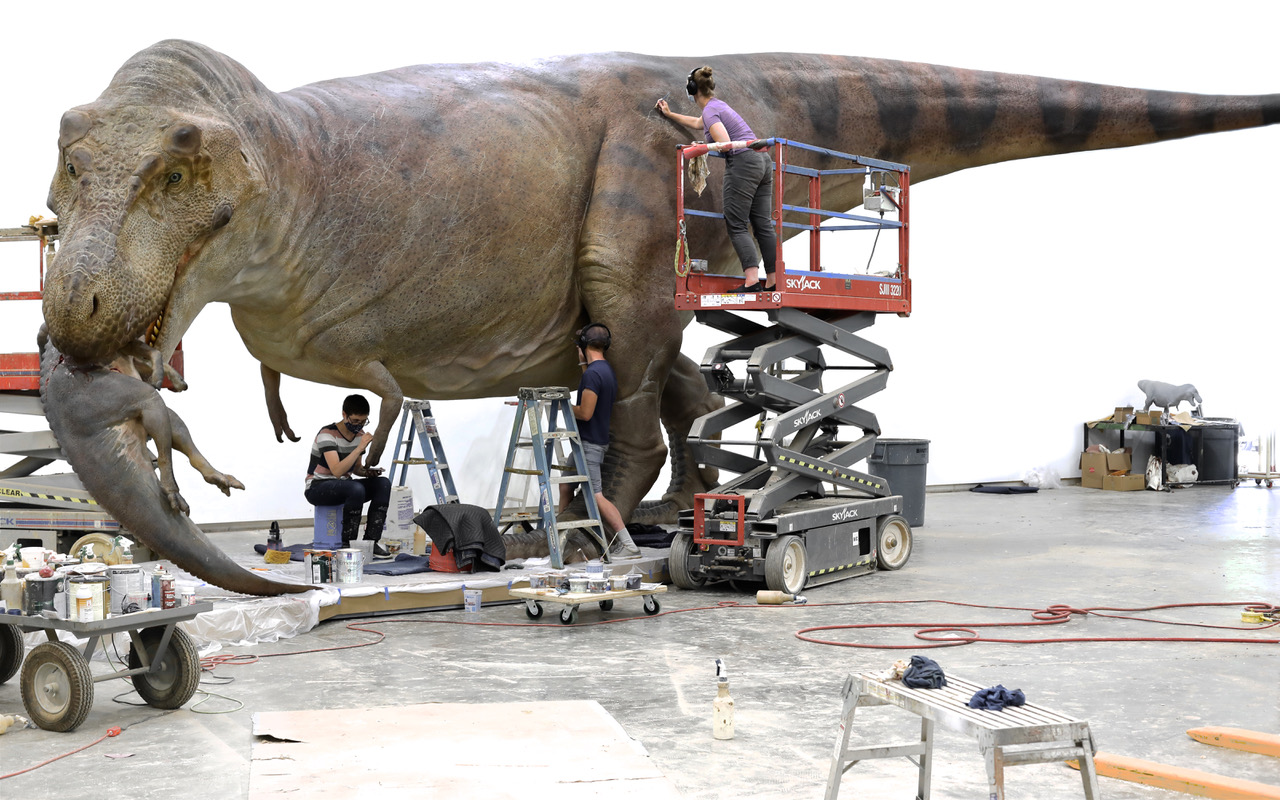
As a component of my work with the Field Museum of Natural History and North Carolina Museum of Natural Sciences, I have also consulted on a number of technical art pieces, including Blue Rhino Studio's life-sized Tyrannosaurus rex reconstruction and Beth Zaiken's Hell Creek Formation mural (both in the FMNH Traveling SUE Exhibition, and the latter also in the permanent SUE exhibit at the Field Museum). I also consulted on art that Liam Elward produced for the Evolving Planet permanent exhibit at Field Museum (Citipati, Anchiornis, Archaeopteryx, Deinonychus, and Tianyuraptor) and for the Cretaceous Creatures program at the NC Museum of Natural Sciences (18 illustrated species and 1 environmental reconstruction).

Museum Outreach
Throughout my career I have been lucky enough to work in several natural history museums (Canadian Museum of Nature, Royal Ontario Museum, Field Museum of Natural History). Museums, and specifically their collections and specimen-based research programs, represent an outstanding venue in which to engage with the public and provide an effective medium for teaching about science and the natural world.
A few of the museum outreach programs I have taken part in are listed here:
January 2020 - December 2020 (postdoc), January 2021 - Present (informal): North Carolina Museum of Natural Sciences. Cretaceous Creatures
In my role as a postdoc at the NCMNS, approx. 50% of my duties involved acting as the project manager for a major in-development pubic education and citizen science program ('Cretaceous Creatures') aimed at middle-school classrooms, making use of fossils and sediment collected from vertebrate microfossil bonebeds in the Hell Creek Formation of Montana, and produced as a component of the NCMNS' 'Dueling Dinosaurs' exhibition and research programs. Much of my role in Cretaceous Creatures focused on designing fossil identification keys for participants, working with graphic artists designing logo and website materials, working with a research assistant to perform sorting and preparing microvertebrate site samples for use in the program, 3D scanning of specimens, assisting in designing and implementing of automated screenwashing equipment, working with developers to create a specimen and educational database system for the program (both for participants and for researchers wishing to make use of data generated from the program), preparing lesson plans to conform to state and federal curriculum requirements, and developing partnerships with other museums to deliver synergized educational opportunities. In-person implementation of the program was delayed due to the COVID-19 pandemic, after which I moved to a new position, but I have remained involved with the project in an advisory and collaborating capacity.
In addition, I have also taken part in several in-gallery specimen-based public engagement programs related to the above-mentioned program.
January 2018 - December 2019: Field Museum. Took part in multiple in-gallery and off-site specimen-based public engagement programs in conjunction with the Exhibitions, Education, and/or Institutional Advancement departments. These include, but are not limited to multiple events focused on 'SUE the T. rex', given my involvement in the design of the permanent exhibit focused on that specimen, as well as performing multiple tours of exhibits, labs, and collections. I also took part in donor events for the Women's Board, Founder's Council, and special visitor events such as 'Meet a Scientist', 'Science Hub', 'EVOLVE', 'Field Museum Adult Sleepover', and public seminar/lecture events such as the 'A. Watson Armour Seminar Series' and the 'Collections Hub' seminar series.
January 2014 – September 2017: Royal Ontario Museum. Took part in multiple in-gallery and off-site specimen-based public engagement programs. These include, but are not limited to March Break school programs, Open House events (ROM Revealed), tours to donors and special guests (e.g. Adam Savage of 'Mythbusters'), ROM 'Big Weekend' events (e.g. ‘Dinosaurs Invade! Weekend’, ‘Fossil Fest Family Funday’, ‘Up Close with Nature’, ‘Brilliant Science Family Fun Day’ event, etc).
May 2010 – November 2011: Canadian Museum of Nature. Took part in multiple in-gallery and off-site specimen-based public engagement programs. These include, but are not limited to performing in-person outreach during events surrounding the grand re-opening of the museum exhibits after major renovations (‘Rediscover Your Museum’), assisting in the set-up, selection and movement of collection objects to gallery spaces, and staff welcome/outreach to VIPs during events surrounding the Royal dedication of ‘Queen’s Lantern’ addition to the museum’s Victoria Memorial Museum Building by Her Majesty Queen Elizabeth II, performing in-person outreach and presentations associated with 'Meet the Experts' events, and assisting with collections-focused Open House events.
A few of the museum outreach programs I have taken part in are listed here:
January 2020 - December 2020 (postdoc), January 2021 - Present (informal): North Carolina Museum of Natural Sciences. Cretaceous Creatures
In my role as a postdoc at the NCMNS, approx. 50% of my duties involved acting as the project manager for a major in-development pubic education and citizen science program ('Cretaceous Creatures') aimed at middle-school classrooms, making use of fossils and sediment collected from vertebrate microfossil bonebeds in the Hell Creek Formation of Montana, and produced as a component of the NCMNS' 'Dueling Dinosaurs' exhibition and research programs. Much of my role in Cretaceous Creatures focused on designing fossil identification keys for participants, working with graphic artists designing logo and website materials, working with a research assistant to perform sorting and preparing microvertebrate site samples for use in the program, 3D scanning of specimens, assisting in designing and implementing of automated screenwashing equipment, working with developers to create a specimen and educational database system for the program (both for participants and for researchers wishing to make use of data generated from the program), preparing lesson plans to conform to state and federal curriculum requirements, and developing partnerships with other museums to deliver synergized educational opportunities. In-person implementation of the program was delayed due to the COVID-19 pandemic, after which I moved to a new position, but I have remained involved with the project in an advisory and collaborating capacity.
In addition, I have also taken part in several in-gallery specimen-based public engagement programs related to the above-mentioned program.
January 2018 - December 2019: Field Museum. Took part in multiple in-gallery and off-site specimen-based public engagement programs in conjunction with the Exhibitions, Education, and/or Institutional Advancement departments. These include, but are not limited to multiple events focused on 'SUE the T. rex', given my involvement in the design of the permanent exhibit focused on that specimen, as well as performing multiple tours of exhibits, labs, and collections. I also took part in donor events for the Women's Board, Founder's Council, and special visitor events such as 'Meet a Scientist', 'Science Hub', 'EVOLVE', 'Field Museum Adult Sleepover', and public seminar/lecture events such as the 'A. Watson Armour Seminar Series' and the 'Collections Hub' seminar series.
January 2014 – September 2017: Royal Ontario Museum. Took part in multiple in-gallery and off-site specimen-based public engagement programs. These include, but are not limited to March Break school programs, Open House events (ROM Revealed), tours to donors and special guests (e.g. Adam Savage of 'Mythbusters'), ROM 'Big Weekend' events (e.g. ‘Dinosaurs Invade! Weekend’, ‘Fossil Fest Family Funday’, ‘Up Close with Nature’, ‘Brilliant Science Family Fun Day’ event, etc).
May 2010 – November 2011: Canadian Museum of Nature. Took part in multiple in-gallery and off-site specimen-based public engagement programs. These include, but are not limited to performing in-person outreach during events surrounding the grand re-opening of the museum exhibits after major renovations (‘Rediscover Your Museum’), assisting in the set-up, selection and movement of collection objects to gallery spaces, and staff welcome/outreach to VIPs during events surrounding the Royal dedication of ‘Queen’s Lantern’ addition to the museum’s Victoria Memorial Museum Building by Her Majesty Queen Elizabeth II, performing in-person outreach and presentations associated with 'Meet the Experts' events, and assisting with collections-focused Open House events.
Science Communication through Social MediaI maintain a personal twitter account (@cullen_thomas) in order to communicate my research and engage in direct dialogue with the public and other stakeholders. While I don't personally feel that knowledge transfer can be as effectively conducted over social media when compared with in-person, specimen-based experiential learning, it nonetheless represents a critical component of effective public science outreach due to the ability to reach a much wider range of audiences.
|
Science TravelsI have previously worked with Science Travels, an organization based out of the University of Ottawa that sends graduate students to provide elementary and high school students in remote or First Nations communities additional science education opportunities. I participated in four-person team sent to northern Ontario (within and between Dryden and Kenora), which visited multiple schools and First Nations communities and performed a series of science workshops/seminars. More information about Science Travels can be found here.
|
|
Geoheritage Day
'Explore Geoheritage Day' is an event organized by the Ottawa-Gatineau Geoheritage Project and the Carleton University Dept. of Earth Sciences, which takes place every October during National Science and Technology Week. The goals of the event are to increase awareness and education about the geological history of the National Capital Region. During the event, volunteers are sent to a variety of geoheritage landmarks in Ottawa and Gatineau, and make themselves available to interact with and educate the public about the natural history of those locations. Maps and descriptions of each site are also available during and before the event, allowing interested members of the public to seek out and learn about multiple sites. During my undergraduate and M.Sc., I worked with the organizers of Explore Geoheritage Day and interacted with the public at a number of different geoheritage sites. More information about this excellent event can be found here and here.
Media Appearances & Press Coverage
Selection of TV/Radio/Online appearances and invited comments:
- https://www.cbc.ca/player/play/2188306499628 (CBC 'The National', coverage of our research on dinosaur facial soft-tissues on Canadian national news broadcast)
- https://www.cbc.ca/radio/quirks/quirks-apr-3-2023-1.6795996 (CBC 'Quirks and Quarks', covering our research on dinosaur facial soft-tissues)
- https://www.youtube.com/watch?v=RslkYNx5rCM (featured in episode of Emily Graslie's 'The Brain Scoop' series, in a segment discussing the development of the 'SUE's World' exhibit).
- https://www.stage773.com/cscf-shows/benmoreyshow (interviewed by Ben Oddo and Morey Hill for their live variety/comedy show "The Ben and Morey Show" at Stage 773 during Chicago Sketchfest 2019. Interview focused on my background, various aspects of palaeontology, my research, and the recently opened 'SUE's World' exhibit).
- http://www.leisureopportunities.co.uk/news/Atlantic-Productions-unveils-animation-for-upcoming-Sue-exhibit-at-Chicagos-Field-Museum/340177 (Mentioned for my contribution, through technical consulting, in the development of Atlantic Productions' life-reconstructions & computer animations used in the Field Museum's SUE exhibit)
- https://www.csmonitor.com/Science/2018/0611/Rise-of-the-Jurassic-Park-generation (interviewed on my views of Jurassic Park, how it changed the public perceptions of dinosaurs, and how it influenced my interest in palaeontology)
- https://www.theglobeandmail.com/technology/science/why-did-birds-live-while-dinosaurs-died-its-a-seedy-story-researcherssay/article29705574/ (quoted in section describing the generation of the hypothesis of the paper being discussed)
- http://blogs.discovermagazine.com/d-brief/2015/07/08/horned-dinosaur-triceratops/ (provided comments on new discovery)
- http://tvo.org/video/programs/museum-diaries/dinos-rediscovered (appeared alongside field crew in 'Museum Diaries' tv program)
- http://www.history.ca/video/#dino-hunt-canada/video (appeared alongside field crew in 'Dino Hunt Canada' tv program)
- http://www.ottawacitizen.com/news/Carleton+University+students+spend+month+studying+Antarctica/4631764/story.html (archive copy here: http://www.uantarctic.org/archives/press/2011/unconventional-classroom.php) (interview about participation in Antarctic expedition)
- https://www.livescience.com/t-rex-had-thin-lips-and-a-gummy-smile-controversial-study-suggests
- https://www.nytimes.com/2023/03/30/science/lips-tyrannosaurus-rex-dinosaur.html
- https://www.theglobeandmail.com/canada/article-dinosaur-lips-canada-scientists/
- https://www-science-org.uml.idm.oclc.org/content/article/t-rex-lips-new-study-suggests
- https://www.reuters.com/lifestyle/science/t-rex-kin-it-was-stiff-upper-lip-not-toothy-grin-2023-03-30/
- https://www.washingtonpost.com/climate-environment/2023/03/30/t-rex-teeth-drawing-study/
- https://www.thebeaverton.com/2023/03/paleontologists-theorize-the-t-rex-had-kissable-lips-and-an-ass-that-wont-quit/
- https://www.abc.net.au/news/science/2023-03-31/jurassic-world-tyrannosaurus-rex-lips-dinosaur/102154156
- https://www.cbc.ca/news/canada/british-columbia/dinosaur-lips-teeth-scientific-study-1.6796407
- https://www.cracked.com/article_26377_6-hilarious-ways-scientists-are-solving-lifes-mysteries.html
- https://www.atlasobscura.com/articles/what-scientists-learn-from-roadkill
- https://arstechnica.com/?post_type=post&p=1463143
- http://www.cbc.ca/news/technology/new-feathered-dinosaur-named-currie-1.4208421
- https://blogs.scientificamerican.com/laelaps/paleo-profile-curries-alberta-hunter/
- https://www.livescience.com/59815-stalker-velociraptor-relative-discovered.html
- http://calgaryherald.com/news/local-news/iconic-dino-hunter-gets-his-own-prehistoric-bird-of-prey
- http://www.calgarysun.com/2017/07/16/alberta-dino-dean-philip-curries-name-given-to-prehistoric-predator
- http://www.dailymail.co.uk/sciencetech/article-4703944/New-species-bird-like-dinosaur-discovered-Canada.html
- http://www.independent.co.uk/news/science/dinosaur-bird-massive-canada-currie-s-alberta-hunter-royal-tyrrell-museum-a7845656.html
- http://phys.org/news/2016-12-dinosaur-bonebeds-biogeographywhat-tiniest-fossils.html
- http://blogs.plos.org/paleocomm/2016/12/21/dinosaur-bonebeds-and-biogeography-what-the-tiniest-fossils-tell-us-about-the-largest-patterns/
- https://blogs.scientificamerican.com/laelaps/paleo-profile-the-evasive-ostrich-seer/
- http://newsroom.carleton.ca/2014/02/19/carleton-science-graduate-makes-major-discovery-seal-evolution/ http://www.nature.ca/en/about-us/museum-news/news/press-releases/graduate-student-makes-major-discovery-about-seal-evolution
- http://www.livescience.com/43663-why-male-female-seals-different.html
- http://www.nunatsiaqonline.ca/stories/article/65674climate_change_could_change _how_seals_mate_research/